
How to Read a Jumper Datasheet: Key Parameters Explained
1. Size / Dimension: The Core Length Parameter
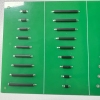
The “Size” column (6, 7.5, 8, 10, 12.5, 15, 17.5, 20, 22.5, 25 in mm) refers to the formed body length of the SMT jumper. This dimension must match the pad span on your PCB layout.
- ✅ Selection Tip: Too short = high risk of cold solder; too long = component lifting & pick-and-place offset during SMT assembly.
- ✅ M-series Mapping: M‑232 = 6mm, M‑233 =7.5mm … up to M‑241 =25mm. Each model corresponds to one fixed dimension. Quote the model number directly on BOMs to prevent shipping errors.
2. Copper / Base Material: Conductivity & Mechanical Toughness
Our standard M-series jumpers adopt H62 Brass as the conductive base material.
- Benefits of H62 Brass: Stable conductivity, balanced hardness, good resistance to cracking during stamping, high mass-production yield, fully compatible with standard lead-free reflow soldering. Compared with pure copper, it delivers better cost control and anti-deformation performance, ideal for signal circuits on industrial control boards & power supply boards.
- ⚠️ Note: For high-current or high-frequency circuits, confirm if pure copper is required. H62 brass works perfectly for general signal routing.
3. Model / Part Number: Unique Identifier for BOM & Traceability
Model codes such as M‑232, M‑233 … M‑241 are manufacturer-specific part numbers. Each model locks in a fixed size, brass grade and epoxy encapsulation.
- Use case: BOM creation, PO placement, incoming QC and batch traceability should reference the part number, not just generic terms like “PCB jumper”.
- Example: M‑234 = 8mm size | H62 Brass | Epoxy encapsulated SMT jumper
4. Surface Material / Encapsulation: Insulation, Thermal Resistance & Oxidation Protection
For this M-series line, the surface material is Epoxy Resin, the critical insulating layer many customers overlook.
- Epoxy Coating Advantages: Excellent dielectric insulation, withstands peak reflow temperatures up to 260°C, protects the H62 brass core from oxidation and accidental short circuits. Moderate hardness prevents damage from SMT nozzle contact.
- ⚠️ Critical Distinction: Epoxy insulated jumpers are NOT the same as bare copper, tin-plated or gold-plated conductive jumpers. Do not substitute them interchangeably.
5. Pack Quantity: Reel Specification for SMT Mass Production
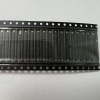
The listed pack quantity (8000 PCS per reel) defines standard tape-and-reel packaging, built for automatic pick-and-place machines.
- Production Tip: Standard 8000pc large reels minimize machine changeover downtime for mass manufacturing. Smaller demo reels can be arranged for prototype sampling upon request.
6. Additional Hidden Must-Check Parameters on Full Jumper Datasheets
Beyond the 5 core fields above, qualified datasheets include these electrical & reliability specs engineers cannot skip:
- Rated Current & Voltage: Verify for high-power circuits to avoid overheating
- Temperature Rating: Storage range + reflow peak temperature (critical for epoxy encapsulated variants)
- Terminal Plating: Tin or gold plating on solder legs, determines solderability & long-term oxidation resistance. Gold plating is preferred for long-lifespan industrial & automotive electronics.
- Dimensional Tolerance: Length & pad tolerance for high-density precision PCB layouts
- Environmental Compliance: RoHS, REACH certificates, mandatory for export, medical and automotive projects
7. Quick Jumper Datasheet Checklist for Engineers
- Confirm jumper body length → match PCB pad span
- Verify base conductor material (H62 brass / pure copper) against current & flex requirements
- Lock in the model/part number for BOM consistency
- Confirm encapsulation or terminal plating (epoxy insulation vs bare/gold/tin plated)
- Double-check thermal rating, current rating and compliance certificates
- Confirm reel pack size to align with your SMT production workflow
FAQ (Google Long-tail Keywords, keep for SEO)
Q1: What applications fit H62 brass epoxy SMT jumpers?
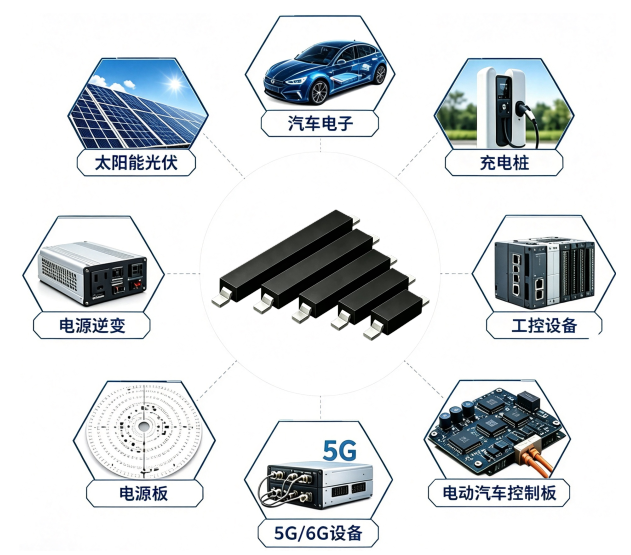
A: Ideal for signal cross-linking on industrial control PCBs, power boards, small home appliance control boards, compatible with standard SMT reflow profiles.
Q2: What is the difference between M‑232 and M‑241?
A: The core difference is formed jumper length: M‑232 =6mm, M‑241=25mm. They share identical H62 brass material, epoxy encapsulation and 8000pcs/reel packaging.
Q3: Are the terminals gold-plated on epoxy jumpers?
A: The epoxy listed under surface material refers to the body insulation layer. Solder terminals can be supplied with tin or gold plating on request, check the full datasheet or contact our engineering team.